
Most computer programs are planned, built, tested, and released. Some are successful and others just gather digital dust. But PowerPoint? Oh no, this one’s different. Its story is more like a full-blown Hollywood script — from humble beginnings to global domination, with plot twists, big-budget buyouts, and a supporting cast that never quits. Few software stories have the drama, the glam, and the staying power of PowerPoint. It’s basically the Forrest Gump of the software world — everywhere, all the time, and weirdly good at telling stories.

The World Before PowerPoint
Enter the Slide Saviors: Nerds with a Vision
PowerPoint 1 is Released
Microsoft Buys In — Fast!
PowerPoint Comes to Windows — and the World Changes
Rise of the Slide Empire
Today
The World Before PowerPoint
Imagine the 1980s—a decade defined by gravity-defying hairstyles, booming stereo systems, and a dazzling display of neon hues. It was an era of bold expression and cultural vibrancy. Yet, while fashion and music embraced innovation, presentations remained firmly rooted in a bygone era—static, uninspired, and longing for transformation. Yes, presentations were stuck in the Stone Age.
Need to give a talk accompanied by projected content? You had two fun options:
- Scribble on a transparent sheet. Think: writing on a glorified sandwich bag with a marker.
- Send your slides off to a photo lab, where they’d turn your work into fancy 35mm film. The catch? You had to wait days to see if it even looked right. And this was an expensive proposition.
There was no Insert Slide button. No Undo option. No clip art. Nothing but stained fingers, Sharpies or similar markers, and a whole lot of praying to the overhead projector Gods. That said, not everyone struggled. Some designers were composed, confident, and had truly mastered the craft, making them highly sought after.

Fun Fact: Mistakes
If you made a mistake back then in the 80s while creating slides, there were no Backspace or Undo keys. It was Start all over again!
PowerPoint hadn’t entered the scene yet — but the slide world was begging for a hero.
Enter the Slide Saviors: Nerds with a Vision
While the rest of the world was dancing to synth-pop, a little startup called Forethought, Inc. in California was cooking up something wild: slide software that didn’t require film, markers, or magic.
About Forethought and Filemaker
Although it was a startup, Forethought was not an unknown name. They already marketed another product called Filemaker, which was a cross-platform relational database application. Filemaker was subsequently acquired by Claris, a subsidiary of Apple Computer.
In walked Robert Gaskins — the idea guy — and Dennis Austin — the coding wizard. Together, they started working on a program that let you build slides on a Macintosh computer. It was like going from carving stone tablets to typing on a magic typewriter.
They first called it Presenter but then rebranded it to PowerPoint. Why did they choose this name? Read the callout box below.
Fun Fact: Why the Name, PowerPoint?
There are two stories about the name, PowerPoint, and they both sort of merged.
Robert Gaskins said, We spent at least a week with everyone trying to think up a new name… The pressure was high, because we were about to ship. Then one morning, when I was taking a shower (where most of history’s great discoveries seem to have occurred), I thought of the name PowerPoint, for no obvious reason. I went in to work and proposed it to other people. No one else much liked it, but I became attached to it. Later that same day, Glenn Hobin, our VP of Sales, returned from a sales trip, and he had an idea for a name: when his airplane was taking off, he had seen out the window along the runway a sign reading “POWER POINT.” I took his independent discovery as a favorable omen, and we were truly out of time; so I forced the issue, and we sent the name PowerPoint off to our lawyers.
Ric Bretschneider said, Before Forethought, the company responsible for the creation of PowerPoint, was bought by Microsoft, they had made their living off a few database products and typing tutor style programs for the Macintosh. There came a time when they were having some trouble making payroll and had to go on a series of quick sales trips to sell inventory that was basically sitting in a warehouse. PowerPoint was under development but might never have made it out to market except for this attempt to generate a bit of revenue. Long story short, the trip was successful and the person responsible for keeping the company afloat was sitting in an airplane window seat watching the tarmac scroll by under the plane as it approached the runway for takeoff and the trip home. Now in some airports there is a specific point on the runway where the plane is supposed to stop and bring their engines up to full power. This point is usually painted on the runway, with the label “POWER POINT.” The name seemed perfect for the product they were producing, and he came home with more than just the money to keep the company afloat.
PowerPoint 1 is Released
In 1987, PowerPoint 1.0 strutted onto the stage — and guess what? It made its grand debut on the Macintosh.
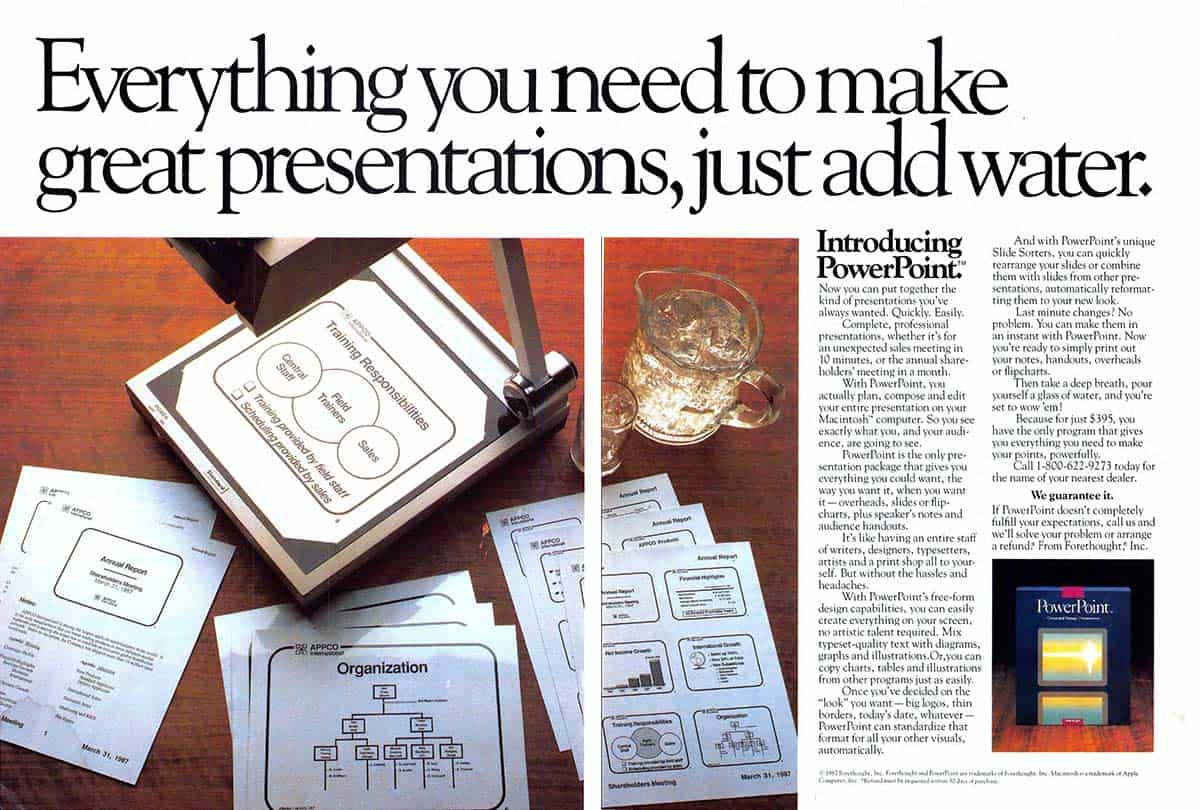
This is the two-page advertisement that Forethought published in several magazines such as Macworld and MacUser to coincide with the release of PowerPoint. Click on the image to view a larger picture.
Fun Fact: No Animations or Color
Back then, PowerPoint could only print black-and-white slides for overhead projectors — no jazzy animations, no click-to-zoom… just pure, old-school slide magic.
In its June 1987 issue, Macworld did a three-page review of PowerPoint and said, PowerPoint, recently released by Forethought, is a management and composition tool that gives you direct, personal control over the production of presentation graphics materials. PowerPoint accomplishes more preparation tasks than any other presentation software, including viewing and rearranging slide sequences, developing a visually unified presentation, and producing bulleted outlines, speaker’s nates, and audience handouts.
Microsoft Buys In — Fast!
Just three months later after PowerPoint made its Mac debut, Microsoft took one look and basically said, “Yep. We want this.”
They slapped down a check for $14 million — which, in today’s terms, could buy you a fleet of Teslas, a small island, or at least a lifetime supply of snacks for your next 10,000 meetings.
When Microsoft bought PowerPoint in 1987, they agreed to a pretty big “no-touchy” clause: don’t move the team! The folks at Forethought wanted to keep their flip-flops firmly planted in California’s Bay Area, where the sun shines and startups sprout like avocados on toast.
Microsoft said, “Cool with us,” and kept the PowerPoint crew right where they were.
To this day, PowerPoint’s core team still calls Microsoft’s Silicon Valley Campus home — proving that sometimes, you really can have your slides and surf too.
Fun Fact: Microsoft Acquisitions
PowerPoint was the very first company Microsoft ever bought. So yes, it’s kind of their favorite child.
PowerPoint Comes to Windows — and the World Changes
By May 1989, PowerPoint was ready for Windows. That meant you didn’t need a fancy Mac anymore to make cool slides — just a PC and some caffeine.
It joined Microsoft Word and Excel as part of the Office Suite and soon became the third musketeer in every office worker’s life.
PC World, in a review of PowerPoint within its August 1990 issue said, The key concept behind PowerPoint is one that originated with desktop publishing: the master page. PowerPoint calls this the master slide, a background layer that holds the elements to be repeated throughout a presentation. Once you’ve created the master slide, you switch to the individual slide layer and begin working image by image, while the master slide stays visible but uneditable. Creating the same show with most other packages would require copying backgrounds from slide to slide-and you couldn’t make global changes.
Fun Fact: Print Transparencies
Early PowerPoint came with tools to print slides on transparencies — because projectors weren’t dead yet. They just didn’t know it.
Imagine Microsoft as the conductor of a grand orchestra—each software program playing its part in a harmonious Windows 3 performance. When PowerPoint was ready for its Windows debut, Microsoft decided to keep it on the down-low—no flashy billboards, no magazine ads, no confetti cannons.
Why the secrecy? Well, Microsoft wanted to highlight its brand-new operating system, Windows 3 as an ecosystem where all software worked seamlessly together. PowerPoint, a rising star in the presentation world, wasn’t supposed to hog the spotlight.
Fun Fact: Understated Launch on Windows
If you dig through old tech magazines from that time, you won’t find a single ad shouting about PowerPoint’s Windows launch—it was a stealthy slide-in rather than a grand entrance!
So next time you fire up PowerPoint on your PC, remember—it didn’t crash onto the scene like a rockstar. It slipped in quietly, ready to shake up the world of presentations — one unsuspecting slide at a time.
Look at this ad about Windows 3, from the September 1990 issue of PC World.
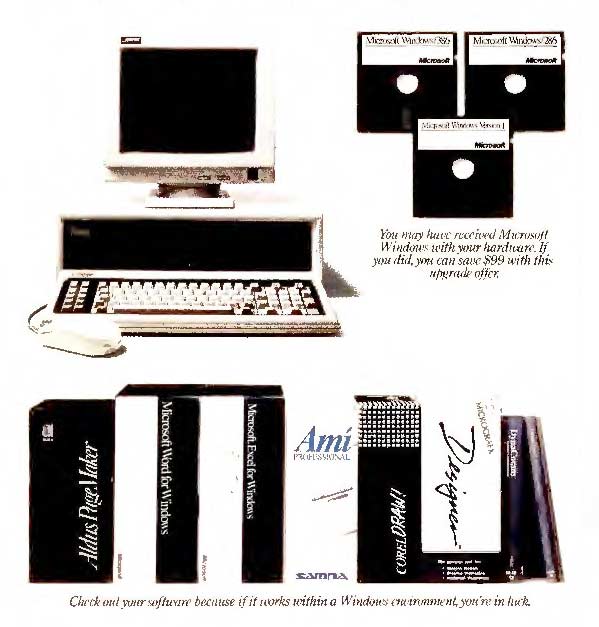
Imagine Microsoft rolling out a flashy advertisement for its Windows 3 software lineup—like a red-carpet event for productivity tools. The spotlight shines on PageMaker, CorelDRAW, and even Ami, a word processor that Lotus scooped up and rebranded. And of course, Word and Excel step onto the scene, waving at the crowd.
But where’s PowerPoint, the new kid on the block? Nowhere to be seen!
PowerPoint’s quiet entrance was more ninja than rockstar—sneaking into the Windows world instead of bursting through the doors. But it didn’t stay in the shadows for long—it soon became one of Microsoft’s biggest successes!
Rise of the Slide Empire
From the ‘90s onward, PowerPoint became the universal language of business. Want to impress your boss? PowerPoint. Launching a startup? PowerPoint. Teaching middle school math? PowerPoint.
By the 2000s, over 30 million PowerPoint presentations were being created every single day. That’s more than the number of sandwiches eaten daily in New York City. Probably.
Fun Fact (or Warning)
Death by PowerPoint became a real thing — because too many people used too many bullet points. But don’t blame PowerPoint — blame boring slides.
Today
Fast forward to the 2020s, and PowerPoint is now smarter than ever. It helps you design your slides, write your speaker notes, and even rehearse your delivery — thanks to AI tools like Copilot.
You can collaborate in real time, integrate live data, and enhance your slides with dynamic visual elements — all with a single click.
PowerPoint started as a way to ditch hand-made transparencies—and ended up becoming the universal storytelling tool for work, school, and everything in between.
From 1980s neon to cloud-based collaboration, it’s been one wild slide.
Related Posts
 Microsoft has been constantly implementing new changes in every release of their Microsoft Office suite, which has always included PowerPoint as one o...
 Ever notice no matter what company you walk into—big, small, startup, or dinosaur—someone, somewhere is clicking through a PowerPoint? It’s like the o...
 Students frequently devote more time to PowerPoint design than actual learning, reducing study efficiency and academic progress. This article explores...
 In today's world, digital technology has completely changed how we communicate, share ideas, and present information. From emails to video calls to fa...